
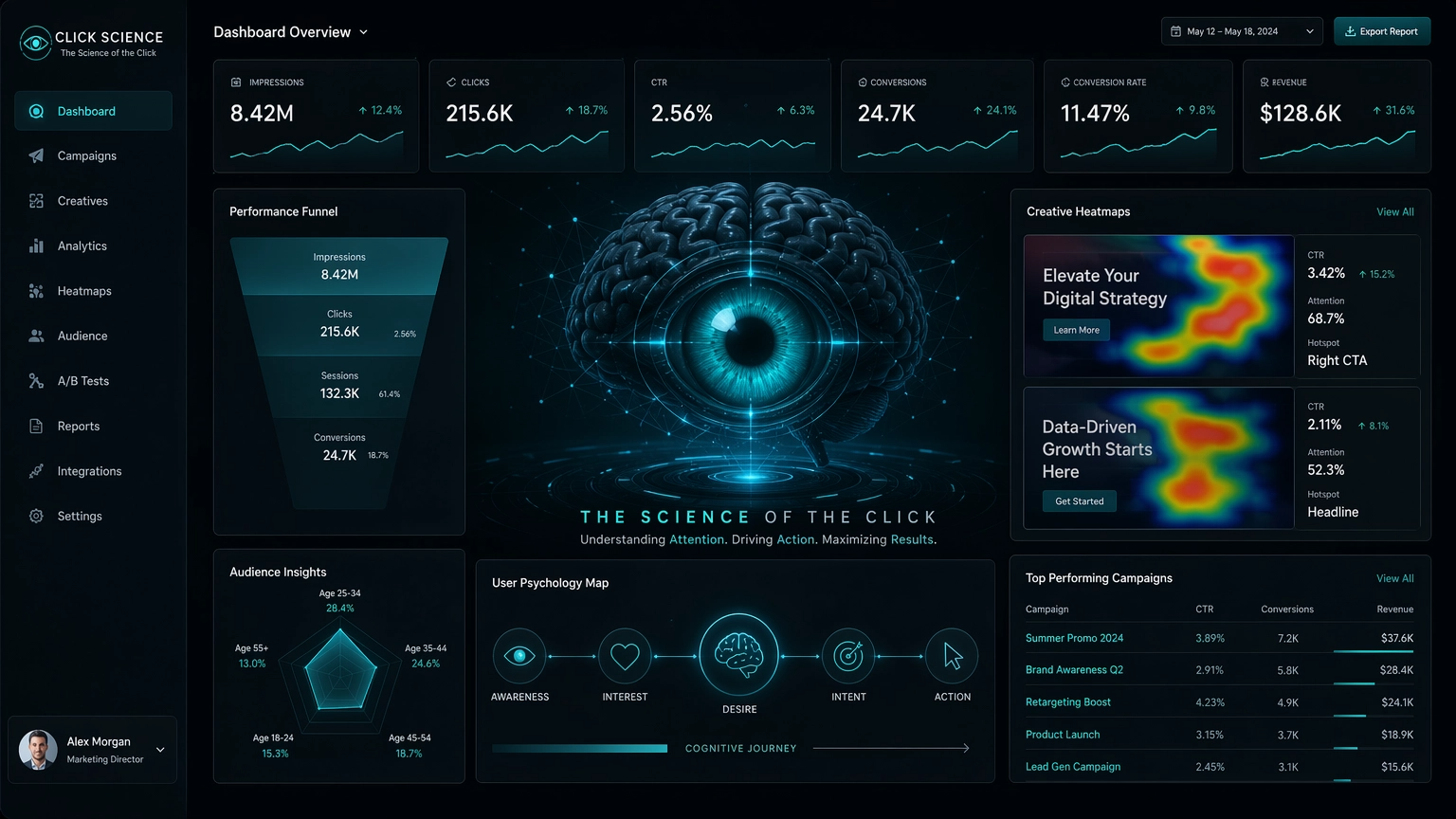
Designing a display ad that converts isn’t merely about aesthetics — it’s about psychology, precision, and purpose. In an online environment where attention spans barely stretch beyond a few seconds, your ad has to compete not just with other ads, but with every possible distraction on the user’s screen. A high-converting display ad is a perfect marriage between visual clarity and strategic persuasion. It draws the eye, evokes curiosity, and compels immediate action — all while staying true to your brand identity.
In This Comprehensive Guide
- The Enduring Power of the Banner Ad
- A Brief History: From the First Click to Modern AI
- The Psychology Behind the Click: Capturing Attention
- Driving Desire: Emotional Triggers and Persuasion
- Static vs. Animated: The Performance Showdown
- The Future of Banner Ads: Hyper-Personalization and Ethics
Unlocking the Mind: The Psychology and Evolution of Banner Ads
1. The Enduring Power of the Banner Ad
Despite predictions of its demise, the banner ad has not only survived but thrived, adapting to new technologies and user behaviors. Its enduring power lies in its ability to deliver a concise message directly to a targeted audience. In an increasingly fragmented media landscape, banner ads offer a consistent visual touchpoint for brands.
They are often the first interaction a potential customer has with your brand, making their design and psychological impact paramount. Understanding how users perceive and react to these digital billboards is crucial for maximizing their effectiveness.
Modern display advertising is no longer about “spraying and praying.” It is about surgical precision. By understanding the subconscious cues that trigger human interest, marketers can bypass the logical “gatekeeper” of the brain and speak directly to the emotional core of the consumer.
2. A Brief History: From the First Click to Modern AI
The journey began in 1994 with the iconic AT&T “You Will” ad on HotWired.com. This blinking rectangle boasted a staggering 44% click-through rate—a figure unimaginable today. Initially, banner ads were simple, static images, but they quickly evolved as marketers realized the power of digital real estate.
The early 2000s saw the rise of pop-ups and intrusive formats, leading to “banner blindness” – a phenomenon where users consciously or unconsciously ignore banner ads. This forced advertisers to innovate, focusing on better targeting and more engaging creatives. Today, AI plays a significant role, optimizing everything from ad placement to creative generation. For instance, platforms like Foreplay.co allow marketers to analyze successful ad creatives and understand historical trends, providing invaluable insights into what has worked and what continues to work in this evolving landscape.
We have moved from the “Wild West” of blinking GIFs to the era of “Native Integration,” where ads are designed to complement the user experience rather than interrupt it. The history of the banner ad is essentially the history of our digital attention economy.
3. The Psychology Behind the Click: Capturing Attention
In a world of information overload, capturing attention is the first and most critical step. Our brains are wired to notice novelty, contrast, and movement. This is why well-designed banner ads leverage these innate human responses.
- Visual Saliency & The Von Restorff Effect: Also known as the “isolation effect,” this principle states that when multiple similar objects are present, the one that differs from the rest is most likely to be remembered. High-contrast ads utilize this to pop against a website’s background.
- F-Pattern & Z-Pattern Scanning: Eye-tracking studies show users scan content in predictable patterns. Placing your value proposition at the start of the “F” and your CTA at the end of the “Z” maximizes the chance of conversion.
- Color Psychology: Colors aren’t just aesthetic; they are emotional triggers. Blue evokes trust, Red creates urgency, and Green is associated with growth and safety. Choosing the right palette can subtly shift a user’s mood.
Tools like Adcreative.ai utilize AI to predict and optimize for these psychological triggers, generating creatives that are more likely to hold attention by analyzing millions of successful data points. You can get 10 free credits to see how AI can enhance your ad’s psychological impact.
4. Driving Desire: Emotional Triggers and Persuasion
Once attention is captured, the next step is to cultivate desire. This involves tapping into deeper human motivations and employing persuasive techniques known as “Neuro-Marketing.”
- Scarcity & Loss Aversion: Humans are more motivated by the fear of losing something than the prospect of gaining something of equal value. Phrases like “Only 2 Left” or “Offer Ends at Midnight” trigger this primal survival instinct.
- Social Proof & The Bandwagon Effect: We look to others to determine correct behavior. Including “Join 50,000+ Happy Customers” in an ad reduces the perceived risk of the click.
- The Halo Effect: If a user likes one aspect of your ad (e.g., a beautiful design or a trusted influencer), they are more likely to have a positive predisposition toward your entire product.
These triggers, when used ethically, can significantly influence a user’s decision-making process. The goal is to create a compelling narrative that resonates with the user’s needs and aspirations, moving them from passive viewer to active lead.
5. Static vs. Animated: The Performance Showdown
The debate between static and animated ads continues. While it might seem that “more movement equals more attention,” the reality is more nuanced. Excessive animation can actually lead to “ad avoidance” as the brain registers it as a distraction.
| Feature | Static Ads | Animated Ads (HTML5/GIF) |
|---|---|---|
| Load Speed | Ultra-Fast | Variable (Heavier) |
| Attention Grab | Relies on Contrast | Relies on Movement |
| Best For | Retargeting & Branding | Storytelling & Complexity |
Modern trends favor subtle, purposeful animation. The key is to test. Robust tracking tools are essential here. ClickMagick is an industry leader for real-time ad tracking, allowing you to precisely measure the performance of both formats and make data-driven decisions based on actual conversion ROI, not just clicks.
6. The Future of Banner Ads: Hyper-Personalization and Ethics
As we look to the future, banner ads will continue to evolve, driven by AI and a focus on user privacy. Hyper-personalization will become the norm, delivering more relevant, less intrusive ads. We are entering the era of “Contextual Intelligence,” where an ad doesn’t just know who you are, but *what you are doing* in that specific moment.
This means more relevant, less intrusive ads that feel like helpful suggestions rather than interruptions. However, this also brings a greater responsibility for ethical design and transparent data usage. Brands that prioritize user trust and deliver genuine value through their advertising will be the ones that succeed in the long term.
If you need professional assistance to audit your funnel or fix specific ad creative issues to ensure your ads are future-proof, the Fiverr Marketplace offers experts who can assist with specialized design needs from $5.
Key Takeaways: The Formula for a Click-Worthy Ad
- Attention is Gold: Leverage visual saliency, high contrast, and emotional resonance to break through banner blindness.
- Desire Drives Action: Use scarcity, social proof, and loss aversion ethically to motivate the user.
- Test Everything: Use A/B testing and real-time tracking to find what works for your specific audience.
- Cohesion Matters: Ensure your ad’s psychological promise is fulfilled on the landing page to prevent “click-regret.”
Recommended Tools for Mastering Ad Psychology & Performance
AdCreative.ai
Generate hundreds of high-conversion banners instantly. AI scans your website to create optimized variations that leverage deep psychological data.
Get 10 Free Credits →Envato Elements
Unlimited downloads of premium stock photos, graphics, and templates. Fuel your creative needs for psychologically impactful ads.
Get Unlimited Assets →ClickMagick
The gold standard for real-time ad tracking. Precisely measure the performance of static vs. animated ads and optimize for ROI.
Start Tracking Free →Foreplay.co
Build your own “swipe file” of winning ads. Analyze high-performing ad structures and understand their historical appeal.
Find Ad Inspiration →Fiverr Marketplace
Need a custom design or funnel audit? Access a global marketplace of freelance designers to polish your ads from $5.
Fix Ads from $5 →Frequently Asked Questions
What is banner blindness?
Banner blindness is a phenomenon where website visitors ignore banner-like information. It developed as users became accustomed to ads and learned to filter them out. Overcoming it requires psychological triggers like high contrast and novelty.
How do emotions influence ad clicks?
Emotions bypass the logical brain. Ads that evoke joy, curiosity, or address pain points (fear of missing out) are significantly more likely to be acted upon than purely informational ads.
Is A/B testing crucial for understanding ad psychology?
Absolutely. A/B testing allows you to empirically determine which psychological triggers (e.g., scarcity vs. social proof) resonate most with your specific audience, turning assumptions into data-backed insights.
Ready to Master the Science of the Click?
By understanding the deep psychological principles and the rich history behind banner advertising, you can transform your campaigns from mere impressions into powerful conversion engines. Embrace the science, leverage the tools, and watch your click-through rates soar.
Dive into the cognitive journey of your audience, apply proven persuasive techniques, and continuously optimize your creatives for maximum impact.
Legal Disclaimer: This comprehensive guide provides insights based on general psychological principles and industry trends. Actual performance may vary due to audience specifics, market dynamics, and creative execution. This content is for informational and educational purposes only and does not constitute financial, marketing, or business advice. WebBannerExperts.com is not responsible for decisions or outcomes resulting from these recommendations.